

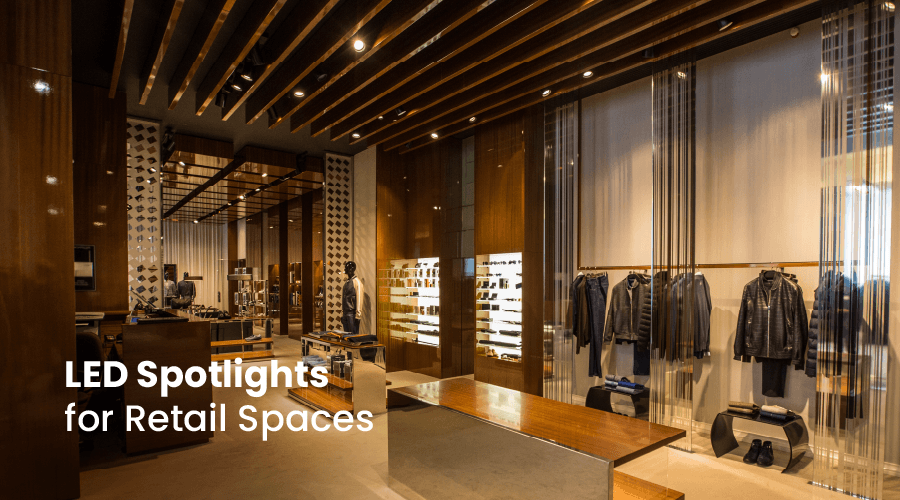
Have you ever thought that when you enter a modern retail store, on most occasions, you start to get that instant sense of comfort? The ambiance captivates you and everything on the shelves looks appealing. Well, you might not realize it, but it’s largely the lighting that gives you that feel-good vibe. The way lighting has been done and the kind of fixtures used is the key to creating a welcoming and comforting environment inside a retail store while highlighting the inventory as well. One lighting solution that truly enables store owners to transform their spaces are LED Spotlights.
Retail spotlights draw attention to products with a narrow, bright beam. Use them over feature displays on top of general ambient light, pick a colour temperature that suits the product, and choose a high CRI (90 or more for fabric, jewellery and food) so colours look true.
Before we deep dive into the why and how of LED spotlights, let us first understand the importance of lighting in retail environments. The way a retail store has been illuminated can influence a shopper’s mood and eventually, their buying decision.
While well-lit retail spaces can make the products stand out, poorly lit can ruin the customers’ mood and may discourage them from making a purchase. And it’s not just about just lighting up the space, it’s also about establishing the brand imagery. For example, you might find a luxury fashion store using warm and soft lighting while a sportswear brand may have their retail spaces light done with brighter lighting to creating a feeling of vibrancy.
This is where LED spotlights come into play, allowing retail store owners to dramatically elevate their spaces and customer experiences.
What beam angle should retail spotlights have?
|
Beam angle |
Best for |
|
Narrow (about 15–25°) |
A single product, a mannequin, a feature piece |
|
Medium (about 30–45°) |
Shelves, counters, small groups of products |
|
Wide (60° or more) |
General fill, wall wash |
Which colour temperature and CRI suit each store type?
|
Store type |
Colour temperature |
CRI target |
|
Jewellery, premium gifts |
Warm white (2700–3000 K) |
90+ |
|
Clothing |
Natural white (3500–4000 K) |
90+ |
|
Bakery, food |
Warm to natural (3000–4000 K) |
90+ |
|
Electronics |
Natural to cool (4000–5000 K) |
80+ |
|
Pharmacy |
Natural to cool (4000–5000 K) |
80+ |
How LED spotlights work?
LED spotlights function by passing an electric current through small LED chips, which emit light. Lenses and reflectors control the spread of light and to achieve the desired brightness and beam angles. While the integrated driver controls the supply of power to produce a steady current, the heat sink helps dissipate heat to ensure efficiency.
The housing (outer casing) holds all these components together and also provide safety against dust and moisture. Nowadays, COB (Chip-on-Board) spotlights are also gaining popularity as they can produce focused lighting with minimum glare. Unlike regular spotlights which use an arrangement of individual LED diodes, COB spotlights have the LED chips are mounted onto a single board directly. This enables COB spotlights to create a more uniform, focused and smoother light. Additionally, COBs are compact in design which results in better heat dissipation, adding to their longevity.
Benefits of LED Spotlights
Let’s quickly take a look at some of the key advantages of using LED spotlights for retail spaces.
Energy Efficiency: In comparison to conventional lighting sources, LED lights are highly energy efficient and consume significantly less energy which in turn leads to lower electricity bills. Now, consider retail stores where you need to keep the lights on for long durations, which makes energy efficient LED spotlights a great choice for retailers to save on their lighting costs. Also, LED lights have long lifespan which translates to lower maintenance costs and less frequent replacements.
Customizable Lighting: Since LED spotlights come in a range of brightness levels and colour temperatures, retailers have the freedom to get the lighting customised as per their needs. Depending on the needs of the space, they can go for warm or cooler lighting.
Focus: This is the key feature that make LED spotlights so special. Since they deliver focused illumination, spotlights can be used to highlight products or select areas where they want their customers’ attention. These lights are ideal for highlighting new arrivals or other promotional stuff.
How many spotlights does a shop need?
Start from the light level you want, then work back to lumens. Published retail guidance quotes about 200–300 lux for aisles and 500–1,000 lux on merchandise displays.
Formula: lumens needed = floor area (m²) × target lux ÷ utilisation factor. Example, simplified: a 500 sq ft shop is about 46.5 m². For 250 lux general light with a utilisation factor of 0.6: 46.5 × 250 ÷ 0.6 ≈ 19,400 lumens, or about 194W of LED at 100 lm/W. Add spotlights on top for displays.
How to use LED Spotlights?
Now that we have understood how LED spotlights work and what benefits they offer in retail environments, let us look at ways we can use them to create inviting spaces.
- Focus matters: If you want to highlight select items in your store, LED spotlights are the just right thing. Take for example a women’s clothing store where you can use LED spotlights to draw shoppers’ attention to mannequins and to highlight your store’s bestsellers.
- Layer your lighting: LED spotlights are meant to do a specific task and therefore, the best way to lift up the overall ambiance of the store is to use a mix of different types of lighting. While spotlights can work as task lights to put focus on certain items or areas inside the store, you must also use ambient lighting for general illumination. Using different types of lights together, with the right colours and brightness levels, can help create visually striking spaces.
- Flexibility in installation: LED spotlights are available in different designs for mounting on ceilings, walls, or tracks. Depending on the layout of the store, retailers can choose the designs The ones with adjustable heads are best suited if the retailer wants to change the direction of the light on a regular basis. There are spotlights with dimming options as well which helps to adjust the light intensity. On top of that, LED spotlights are easy to install and can be effortlessly integrated into existing setup.
Recessed, surface or track spotlights?
|
Type |
Needs false ceiling |
Re-aimable |
Best for |
|
Recessed |
Yes |
Limited |
Clean ceilings, fixed layouts |
|
Surface |
No |
Some |
Rented shops, plain ceilings |
|
Track |
No |
Yes, easily |
Changing displays, seasonal layouts |
A sample lighting plan by zone
|
Zone |
Light |
Level to aim for |
|
Entrance |
Wide fill plus a feature spotlight |
Brighter than the street at dusk [CONFIRM] |
|
Aisles |
Panels or downlights |
About 200–300 lux |
|
Displays |
Narrow or medium spotlights |
About 500–1,000 lux |
|
Billing counter |
Task light |
About 200–300 lux |
|
Trial room |
Soft, even light |
About 500–1,000 lux |
Energy efficient and versatile, LED spotlights provide focused illumination which helps the retailers to create visually inviting spaces and highlight specific sections and products of their choice. It’s essentially the focus and flexibility the LED spotlights offer, which makes them a great choice for any retail store. If you are looking for high quality lights for a retail store, you can always go for Orient Electric’s range of LED spotlights and COB lights, which come with surge protection, superior lenses, high lumen efficacy, long lifespan, ease of installation, and wide colour options.
FAQs
Q: How many spotlights do I need for a 500 sq ft shop?
A: Calculate general light first: about 19,400 lumens for 250 lux in a 46.5 m² shop at a 0.6 utilisation factor, then add spotlights over displays. With 800-lumen spotlights that is roughly 24 for general light, so most shops mix panels and spotlights.
Q: What beam angle is best for retail displays?
A: Use a narrow beam (about 15–25°) for a single product or mannequin, a medium beam (about 30–45°) for shelves and counters, and wide beams for general fill. Adjustable-head spotlights let you change the angle as displays change.
Q: What colour temperature is best for a clothing store, jeweller or grocery shop?
A: Jewellers usually choose warm white (2700–3000 K), clothing stores natural white (3500–4000 K), and grocery or electronics stores natural to cool white (4000–5000 K). Keep one colour temperature throughout a zone so products look consistent.
Q: What is CRI and why does it matter in retail?
A: CRI, the colour rendering index, scores from 0 to 100 how accurately a light shows colours. A higher CRI makes fabric, food, skin tones and jewellery look true, which helps customers trust what they see. Aim for 90 or more where colour matters.
Q: Should a shop use spotlights or track lights?
A: Use track lights if displays change often, because you can slide and re-aim each head without rewiring. Use fixed spotlights for stable layouts. Both give the same focused beam; the difference is flexibility.
Q: Can I install spotlights in a rented shop with no false ceiling?
A: Yes. Surface-mounted spotlights and track lights fix on the existing ceiling and need no false ceiling or cut-outs, so they can be removed when you leave. Check the load and wiring with an electrician.